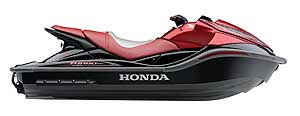
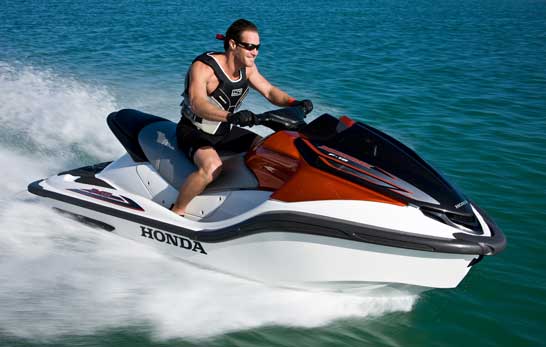
Honda AquaTrax F15-x: True Power
Want the inside scoop on personal watercraft horsepower ratings? Read on.
September 26, 2008

What's in a number? Maybe less than you think. The number on the hull of a PWC, or the cowl of an outboard, never says "horsepower" because it's just a label, not an indicator of real power output.
Editor's Note: Honda ceased production of PWCs after the 2009 model year. However, since there's always interest in used models we have retained this article for interested parties.
When shopping for a high-performance watercraft, pay no attention to the horsepower number on the spec sheet. It has little bearing on the ultimate performance of the boat. Here's why.
About a year ago, when I got my first look at the preliminary specs for the new AquaTrax F15-X, I figured Honda was going to be a day late and a dollar short in the race across the lake. Rated at just 200 hp, how could it compete with the 250-hp Kawasaki Ultra 250X and the 255-hp Sea-Doo RXT-X? Honda assured me its new AquaTrax would deliver "competitive performance," and they were right. With a top speed of 66 mph, the F15-X is about as fast as the Kawasaki, which I've clocked at 66.4 mph, and just 2 mph slower than the Sea-Doo. And if we compare the real horsepower of each boat, we'll see that there is a lot more to real-world performance than just horsepower.
How much power do these boats really make? One way to tell is to test each engine on a dyno, which is a lot of trouble. Especially since the government has already done that chore for us. When the manufacturers certify their engines for emissions compliance, they are required to submit a long table of performance data, which includes the engine's power output. This information is published on a EPA website that we can all study. And it takes a lot of study to find the info we are looking for, because each engine is listed by a model code used by the manufacturers, and the PWC are mixed in with outboard motors. Also, this data not indicate true peak power because for the purpose of emissions testing, manufacturers are allowed to test at up to 5 percent less than peak rpm, and they test with a spec fuel called Indolene in a lab environment. The power output is measured in kilowatts, which you can convert to horsepower: KW X 1.341 = HP.
The current table lists the engines that power the Sea-Doo RXT-X, Honda F15-X, Kawasaki Ultra 250X, and the Yamaha WaveRunner FX SHO, each at peak rpm. Here's what was reported to the EPA:
BRP (Sea-Doo) HO SCIC: EPA Certified Power 174 kw (233 hp)-Advertised Power 255 hp
Kawasaki JT1500B8: EPA Certified Power 184 kw (247 hp) )-Advertised Power 250 hp
Yamaha FX SHO: EPA Certified Power 151 kw (202 hp) )-Advertised Power not published
Honda ARX1500T3: EPA Certified Power 147 kw (197 hp) )-Advertised Power 197.3 hp
What we see is a range of 50 hp between the Honda and the Kawaski, boats that produce the same top speed. The Sea-Doo is fastest by about 2 mph, even though it really makes 14 less horsepower than the Kawasaki. Or look at it this way"¦the Sea-Doo is only 2 mph faster than the Honda, even though it makes 36 more hp. Now consider that there's also a spread of 86 pounds in published dry weight between the 818-pound Sea-Doo and the 904-pound Kawasaki. Other factors that determine ultimate performance include hull shape and length, pump efficiency, the design of the intake grate, the running angle of the hull, availability of adjustable pump nozzle trim, and location of the rider and fuel tank on the boat. And I imagine that at 65 mph, even aerodynamics comes into play. There's also a diminishing return to the horsepower-to-speed game - as speed increases, it takes more and more power to go a little faster, if that makes sense.
But wait! How does BRP get away with claiming its engine makes 255 hp when according to its EPA certification, it really makes 233 hp? It's called "allowance for manufacturing tolerance." Years ago, the members of the National Marine Manufacturers Association (NMMA) agreed to a standard that provides a plus/minus 10 percent leeway in advertised horsepower from actual horsepower. This permits outboard manufacturers to group motors into neat categories in nice, round horsepower ratings. For example, a motor than made 34.2 hp in testing could be sold as a "35." Because who wants to buy the new Johnson 34.2 outboard? This makes sense, because a motor never tests out to a nice, round number. So if the Kawasaki Ultra 250X really makes 247 hp, close enough. Note that BRP has multiplied the real horsepower (233) by just less than 10 percent to get to the marketing horsepower (255), which just happens to be 5 horsepower more than the rating of the Kawasaki. It's just this sort of monkey-business that caused Yamaha to stop publishing a power rating this year. Don't you love marketing?